Inside the $33.4 Billion Price Tag of the US War With Iran — And the Weapons Stockpile It Drained
By Editorial Staff•Tue, Sep 15, 2026
Months of direct military confrontation between the United States and Iran — fought with fighter jets, warships, and missile defense systems — has come with a steep financial and material cost, according to a new government watchdog report detailing the toll of "Operation Epic Fury."
The report, compiled by the Lead Inspector General with coordinated oversight from the Department of Defense, the Department of State, and USAID, covers the operation from its launch on February 28, 2026, through June 30 of the same year.
A $33.4 Billion Operation — and Rising
As of June 29, the Pentagon estimated the total cost of the operation at $33.4 billion. That figure doesn't account for infrastructure repairs, future reconstruction, or the war's broader economic impact, meaning the final cost will likely climb higher.
The breakdown includes $22.3 billion in expended munitions, $7.4 billion in additional operational costs, and $3.7 billion to replace damaged or destroyed equipment. Complicating matters further, Congress never allocated dedicated funding for the operation in the 2026 fiscal year, forcing the military to draw from its standard budget — making it harder to track the war's true total cost.
Of the $7.4 billion classified as mandatory expenditure through June 30, roughly 90% fell under "Operations and Maintenance," covering daily military activity, troop support, and equipment upkeep. About $4.9 billion of that has already been disbursed, broken down as follows:
Flying Hour Program: $691.1 million
Ship Operations: $647.7 million
Base Support: $405 million
Maneuver Units: $385.3 million
An additional $365.1 million in commitments remained outstanding as of June 30.
Pentagon Requests $67.1 Billion More
To cover costs beyond what's already been spent, the administration has asked Congress for $87.6 billion in supplemental funding, with $67.1 billion earmarked specifically for the Department of Defense. The largest allocations include:
$21 billion for ammunition
$17.3 billion for operational costs
$12.1 billion for classified programs
$5.1 billion for cybersecurity and autonomous systems
$4 billion for airborne moving target indication and space data networks
$2.4 billion for drones
$1.7 billion for military equipment
$1.5 billion for fuel
$800 million for the National Guard
Defense Secretary Pete Hegseth has warned that without this additional funding, the Pentagon could struggle to pay troops, replace expended weapons, and maintain military operations globally.
Ammunition Costs Strain the Stockpile
Ammunition represents the single largest expense of the war, with the Pentagon estimating $22.3 billion spent by June 30 — a figure that largely reflects the cost of restocking depleted supplies.
That level of consumption has left a gap in the US strategic weapons stockpile and exposed vulnerabilities in the defense industry's supply chain. The Defense Department cited shortages of solid rocket motors, high-grade explosives, propellants, and skilled manufacturing labor as key obstacles. The report notes that expanding production capacity will take significant time, meaning funding alone won't quickly resolve the shortfall.
Aircraft and Drone Losses
Several US aircraft and drones were destroyed or damaged during the operation, according to official figures:
F-15E: 4 destroyed (3 from friendly fire, 1 from enemy attack)
F-35A: 1 damaged by enemy attack over Iran
A-10: 1 destroyed after being abandoned during a search-and-rescue mission
KC-135: 7 damaged or destroyed
E-3: 1 damaged
HH-60W: 1 damaged
MQ-4C: 1 crashed
AH-6: 4 destroyed by US forces after being deemed unrecoverable
AH-64: 1 shot down over the Strait of Hormuz
MH-60: 1 crashed in the Arabian Sea
MQ-9: up to 30 destroyed across multiple incidents
Notably, three of the four F-15E losses resulted from friendly fire rather than enemy action.
Damage to Bases and Diplomatic Facilities
Iranian attacks damaged or destroyed hundreds of buildings and facilities at US bases across Kuwait, Bahrain, Qatar, the United Arab Emirates, Saudi Arabia, Iraq, Oman, and Jordan. Separately, damage to US diplomatic facilities in Iraq, Kuwait, Saudi Arabia, and the UAE is estimated at $184 million.
Troop Casualties
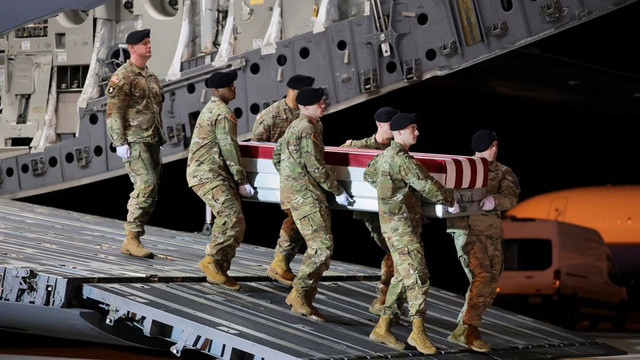
Between February 28 and June 30, seven US service members were killed in action, with additional non-combat casualties also reported during the same period.
#Asia-Pacific#asia-pacific#War in Iran#Operation Epic Fury#US Military Spending#Pentagon#Department of Defense#Pete Hegseth#US Troops#Military Equipment Losses#Ammunition Shortage#National Security
Up next

Grassroots Groups Make a Last-Ditch Push to Unseat Rep. Nicole Malliotakis

You Can See Everything” Edges Out “Clayface” for No. 1 at Friday Box Office With $3.56 Million

Jennifer Lawrence on Her Breast Lift, “Baby Botox” and the Procedures She Won’t Do

Wales Make Four Changes for Women’s Rugby League World Cup Clash With Samoa

Florida Begins Notifying Victims of DMV Data Breach Tied to Stolen Law Enforcement Credentials

Finland Sees Assault Reports Climb More Than 10%, Putting 2026 on Track for a Record
Most popular
1